
If a thing is free to be good it is also free to be bad. And free will is what has made evil possible. Why, then, did God give them free will? Because free will, though it
C.S. Lewis, Mere Christianity
makes evil possible, is also the only thing that makes possible any love
or goodness or joy worth having.
A world of creatures that worked like machines would hardly
be worth creating. The happiness which God designs for His higher creatures is the happiness of being freely, voluntarily united to Him and to each other in an ecstasy of love and delight compared with which the most rapturous love between a man and a woman on this earth is mere milk and water. And for that they must be free.
Would it surprise you to learn that evil does not exist? By that I mean, evil does not exist independently. It is not a force or object of its own. Things that do exist have substance, recognizable features, a clear shape or purpose, and the ability to interact with other things in the world. Though the consequences of evil are recognizable, evil has no substance, no independent form, and no purpose. None of the characteristics scientists and philosophers have associated with the objects and forces of reality for thousands of years.
This is consistent with the typical Christian view of reality. When Abraham asked God’s name, God replied, “I am that I am” (Exodus 3:14). Many other I am statements appear throughout the Bible. We believe God is declaring himself the uncreated source of all being. If this is true, then everything that exists; every real substance, object or force, and everything that has being and purpose, originates in God who is the source of all being and purpose.
Evil, on the other hand, does not come from or belong to the reality of God. It is the word we use when the order, purpose, or integrity of real being breaks down or is missing. It describes a lack or loss that occurs when real things no longer function as God intended. When they no longer reflect the goodness, order, or purpose for which they are created.
Why Evil is an Absence and Not a Thing
Consider the way real things exist and function. Photons of light carry energy from the sun and warm the earth; a rock occupies space and exerts weight on the ground. A magnet generates a field that pulls certain metal objects toward it. Gravity exerts mass attraction between larger and smaller objects. A sound wave moves through the air, setting molecules in motion and creating vibrations in the ear.
Evil, by contrast, possesses none of these qualities. It has no substance or energy of its own. It cannot move, radiate, or act independently, nor does it have essence, purpose, or the ability to exert force. Evil has no self-sustaining existence. Instead, evil is best described as an effect that occurs only in the absence of something that does exist.
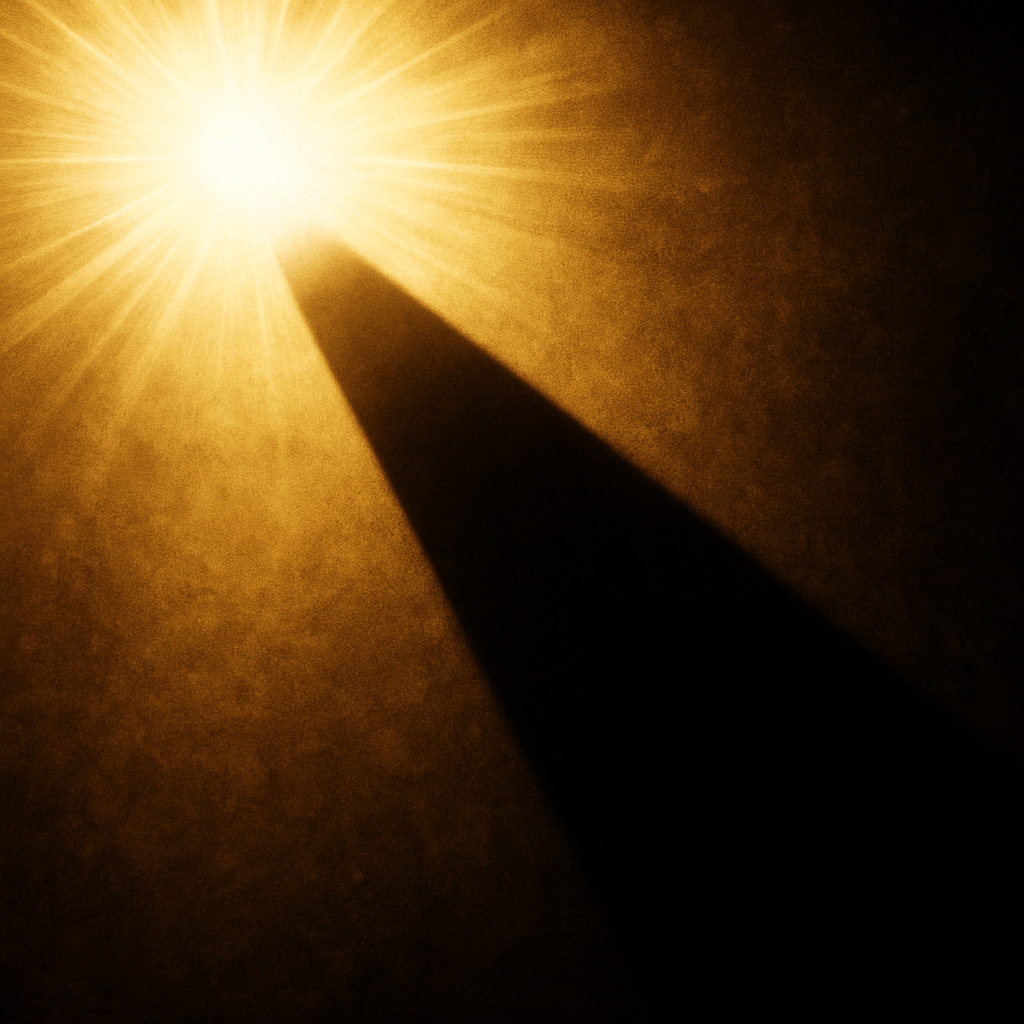
For example, consider how a shadow forms where light is interrupted or blocked. Darkness occurs when the sun sets. Cold is felt when heat is lost. Water pipes freeze and burst in the absence of enough heat. A tear in fabric occurs when threads are broken. In each example, an effect only occurs when real objects or forces are reduced, removed, broken, or disrupted in some way. Evil arises in much the same way, though with one crucial difference. Unlike natural absences and disruptions, evil does not occur spontaneously. It is not a natural or even inevitable condition. Just as a hole in undisturbed ground appears only when someone uses a shovel to remove the earth, evil requires a conscious actor to make a choice. Though no metaphor is perfect, this image of absence shaped by acts of will offers an important glimpse into the origins of evil.
The Metaphysical Reality of Goodness
To grasp the connection between the effects of evil and human will, we must start with the understanding that the physical universe is not the whole of existence. There is another, equally real dimension of reality that influences how we think, feel, and act, even though it cannot be measured or described in physical terms. A network of forces, qualities, patterns of meaning, and values that exist beyond the physical world, but still have structure, purpose, and causal power. Some describe this as phenomenological or metaphysical reality. Whatever name we give it, think of it as the universe of mind or soul that shapes the direction and outcomes of human existence and lived experience.
In this real but invisible part of reality, things do not depend on matter or measurable energy to exist. Instead of objects or forces of physical substance, the elements that form our metaphysical reality exist as intelligible patterns or principles that have function, purpose, and the capacity to shape outcomes within the physical world. Truth, beauty, love, justice, consciousness, mathematical order, integrity, and wisdom are as real and active as photons, heat and magnets are in the physical world. And they shape the patterns, behaviours, and possibilities of our physical reality. For example:
- Truth corrects falsehood, brings clarity, and orders thought. It exerts intellectual force.
- Love unites, inspires sacrifice, and transforms character, It is the energy of relationship.
- Justice restores balance and upholds order. It secures trust and common good.
- Beauty awakens delight and admiration. It draws the heart toward peace.
- Wisdom shapes judgment and directs purpose. It illuminates understanding.
- Integrity aligns conscience with action with conviction. It holds the self together.
Each of these invisible metaphysical components of reality becomes visible in the way they enable us to think logically, perceive rightly, act justly, and love well. They shape our thoughts, choices, and relationships, guiding us toward what is good. For goodness is a deeper order of existence that underlies and sustains the whole network of reality.
Just as photons and heat from the sun are traceable expressions of physical energy, the elements of metaphysical reality are traceable to an even greater source. A creator God who holds every form of reality together and radiates goodness in the process. Every aspect of both the physical and metaphysical realms draws its vitality from that source. Goodness functions as the metaphysical equivalent of pure light. Where physical energy animates matter, goodness animates being; it is the radiant core from which all order flows. This meansgoodness is not simply a moral category or descriptive quality. It is the essence of physical and metaphysical reality. And if God exists as the uncaused cause, the self-sustaining and eternal source at the centre of it all, then goodness, which radiates from God, is as real as the light radiating from the sun. The metaphysical photons of goodness energise the conscious components of our world.
What about Evil Beings?
This raises an important question: If evil has no substance or independent existence, how can we account for beings who appear to embody evil? Beings named and described in Scripture as devil and demons, or even human beings throughout history who commit terrible atrocities? For the answer, we must remember that evil is entirely dependent on the choices of conscious beings who use the shadow of evil to extend its effects.
Since evil has no being or substance of its own, it arises only when conscious beings deliberately turn away from what is good. Like a solar eclipse, such a person turns their back to the light of goodness and stands between that light and the world around them. They do not create darkness; rather, by blocking the light, they cast a shadow over everything within their influence.
The choices and actions of those who cast these metaphysical shadows have real power to shape the world. By turning away from goodness, they not only block its light but also distort, confuse, and conceal the true nature of what is meant to shine and flourish. These actions undermine understanding, disrupt harmony, and hinder the growth and well-being of both individuals and the wider community. In turning from the good, reality itself becomes twisted, and the capacity of people and things to thrive as they should is diminished.
Yet even in corruption, every created being continues to draw some measure of life and existence from goodness, for nothing can exist apart from God. Though the quality of that existence may be damaged by varying degrees of separation from Him, it still depends entirely on His sustaining presence.
Freedom, the divine gift that makes love genuine, allows for the possibility that created beings may turn and go their own way. When this turning occurs, our capacities for love, creativity, and reason remain, but our desires and motives become disordered and misdirected. Manipulation disguises itself as love. Violence presents itself as justice. Self-interest masquerades as freedom. The longing for beauty turns into the hunger for praise. The will to create becomes the will to possess. The search for meaning collapses into the pursuit of power or wealth.
Are there demons and other beings so far gone that they exist only as the personification of evil and are beyond all hope? Though some passages in Scripture suggest this possibility, it is not true of human beings. We need not speculate about the mysteries of devils and demons to understand the metaphysical effects of evil and how to resist them.
Even when a human being becomes so deeply corrupted that the absence of good appears almost total, what we witness is not a new kind of being or power called evil, but a profound and reversible distortion of being itself. All evil originates in acts of will. The choices of conscious beings who misuse their freedom and resist the goodness of God. Even the most corrupted creature is not sustained by darkness, but by the remnants of divine life and freedom misused. The tragedy of evil lies precisely in this dependence: it cannot create, only corrupt; it cannot sustain, only consume.
Why Evil Was Not and Cannot Be Created
If God is the source of everything that exists, it is reasonable to ask whether God also created evil. However, it should be clear by this point the answer is no. Not because God excluded something from creation, but because evil is not something that can be created.
Unlike goodness, which has constructive purpose and carries the metaphysical energy of goodness that comes from God, evil is always derivative. It has no particles, no substance, and no originating force. It only arises when we actively turn away from or deflect God’s goodness. Therefore, evil is a negative condition, not a constructive creation. A fading of goodness from the mind and will of rational beings.
Though evil cannot exert independent force, the effects of evil are clearly apparent, just as darkness limits vision or cold stings the skin. But the intensity of evil varies. The darkness of a cave is deeper than the night beneath a moonlit sky, not because darkness expands, but because light is blocked to one degree or another. In the same way, the effects of evil vary in intensity not because it grows, but because goodness is blocked or refused to varying degrees:
- A politician accepts a bribe, choosing personal gain over justice and the common good, thereby blocking a small but significant measure of goodness in governance.
- Civilians suffer and die in war, even when not deliberately targeted, as the refusal or failure to fully protect innocent life allows suffering and destruction to occur.
- Whole populations are deliberately killed in acts of genocide, where the rejection of goodness is absolute, and evil manifests in its most intense and systematic form.
Goodness, by contrast, is substantive and radiant. It is the metaphysical energy that originates in God and animates being. It is meant to be absorbed, reflected, and refracted throughout creation. As the sun shines and planets reflect, God shines goodness, and human beings are meant to mirror that goodness. Though God is the creator of all that exists, God is not the creator of evil because evil cannot be created. It is the shadowing effect of conscious beings who turn away from the light of divine goodness. It is the result of disrupting and distorting what was made to shine with truth, beauty, and love.
Evil as Illusion with Real Effects
Another way to conceptualise evil is to think of it as a kind of illusion. Illusions can occur naturally or deliberately. A mirage in the desert can occur when light is distorted by rising heat waves. A magician can use misdirection to create an illusion. Either way, there is a distortion or misalignment in the way our senses, mind and reality interact. And even though illusions lack any material presence of their own, they can have a powerful effect on real beings.
A desert mirage cannot produce water, but it can deceive and compel a thirsty person to run toward it and deteriorate more quickly. The magician can plant suggestions and use sleight of hand with real objects to misdirect our attention and convince us something false is real. Evil may also be understood as a compelling illusion that depends on distortion and misdirection.
However, unlike the desert mirage, the illusory effects of evil do not occur naturally. They occur when rationale beings make certain choices, deliberate or otherwise. For example, in the Genesis story, a being described as a serpent made a conscious decision to deceive Adam and Eve. Then, throughout history, we find countless human beings who deliberately distorted something good to lure others away from the truth for their own purposes.
However, human beings can also become victims of their own illusions when pride, temptation, or false desires cloud the light of goodness and truth. False narratives create illusions about what is desirable, powerful, or right and they have real effects when people embrace false promises, misguided values, and deceptive appearances. They lose sight of authentic goodness and wellbeing and act in ways that lead to real frustration, harm and even destruction. To call evil an illusion is not to diminish its devastation, but to expose its weakness. It has no creative power of its own; it can only counterfeit and corrupt. While the consequences of evil are tragically real and often catastrophic, it has no power of its own. It is always a lie mistaken for something good. This underscores the claim that evil is a rejection or withholding of good, not an equal or independent force in opposition to it.
Can God Eliminate Evil?
If you are asking whether God can simply eradicate evil, then the answer is no. If you are asking whether evil will one day cease to be a problem, then the answer is yes.
This response may surprise you, but we must start with the understanding that love is the essence of God’s being (1 John 4:8 and 4:16). Genuine love is freely given and freely received and never forced or coerced. Love and freedom depend on one another. This sets true love apart from responses driven by biology, self-interest, or cultural habit.
God created human beings to exist with freedom because love, not control, is the essence of God’s nature. However, the same freedom that makes love possible also makes the rejection of love and risk of evil possible. This potential for evil is not a flaw in creation but a consequence of genuine love and freedom. Without freedom, goodness could be automatic but never loving.
This means, with freedom comes responsibility. To choose good is to participate in God’s creative order, reflecting the light of divine goodness back into the world. To choose evil is to turn away from that light, falling into the shadows and illusions that distort what is real. Freedom marks the edge between participation in the light of being and participation in illusions of being.
This helps explain why asking whether God can eliminate evil is like asking whether God can create a rock so heavy even God cannot lift it. Both questions describe logical contradictions. To remove evil entirely would mean removing the very freedom that makes love and goodness possible. The issue is not that God lacks power, but that such an act would contradict the logic and order of reality itself. God’s power always operates in harmony with truth, goodness, love, and reason, and never against them.
Even if we overlook the logical impossibilities, only two outcomes remain. Either God eradicates all created beings that possess freedom of will, or God’s presence and goodness become so overwhelming that choice ceases to exist, and with it, the possibility of genuine love. In such a world, freedom would be extinguished, goodness would no longer be chosen but imposed, and evil would disappear only at the cost of love itself.
If we modify the question and ask whether the risk and problems of evil can be overcome, then the answer is yes. For you see, evil ends when the conditions for evil are exhausted.
The Bible reveals God’s promise that evil will one day be overcome without abolishing freedom or coercing human will. Instead, scripture describes a future state of being in which freedom is perfected and evil ceases to be a problem, not by destroying something, but through the fulfilment of freedom and a process called redemption.
In that future state of being, human will remains truly free but is no longer divided against itself. Evil is overcome when all that exists freely participates in the light of God’s goodness. Unpacking the meaning and process of redemption is another post for another time.
The Ultimate Tragedy of Evil
The tragedy of evil lies not in its power, but in its illusion. It mimics form without substance, deceives the eye, and misleads the will. It disguises absence as presence and falsehood as truth. Evil is the distortion of what was meant to be brilliantly clear. Yet even this tragedy reveals something profound: that goodness is the true substance of existence, and that evil, however dark or enduring it may seem, can never outlast the light from which it hides.
God, the loving source, and sustainer of all being, created neither darkness nor illusion, but freedom. Within that freedom lies the great drama of creation. Every conscious being is invited to turn toward the light of God’s goodness, but each retains the freedom to turn away. To turn toward it is to participate in life itself; to turn away is to diminish one’s own being and to inhabit the mirage of self over the reality of God.
In the end, the story of good and evil is not one of equal, opposing forces, but of radiance and its refusal. The eternal light of God’s goodness remains forever undiminished, self-sustaining, and waiting to be reflected once more in every soul that freely chooses to see.
What’s Missing from this Post?
This post explores how evil, though it has no real existence of its own, can still manifest in tangible ways through the conscious misuse of human freedom. It does not, however, address the broader theological questions of how God responds to evil or how evil will ultimately be overcome without sacrificing freedom or contradicting God’s love. Nor does it delve into the related concept of sin—which explains why human beings are inclined to misuse free will, how this tendency gives rise to evil outcomes, and how God takes loving responsibility for creating us with the freedom to choose despite its risks. These questions will be explored in future posts.

 Way of the White Stone
Leave a comment